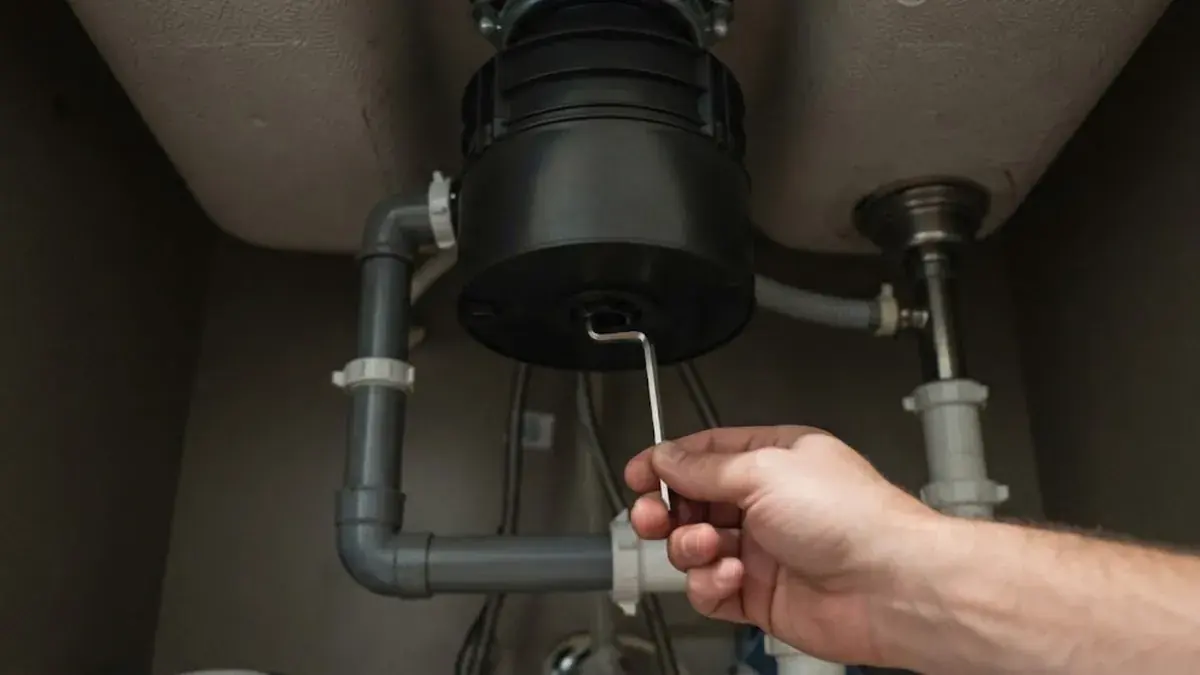
If your garbage disposal hums but does not spin, the flywheel is jammed. Turn off the wall switch and the breaker, then use a hex wrench in the socket at the bottom of the unit to rock it free, remove any visible object with tongs and press the red reset button. Never put your hand in the disposal. If it still will not run, or if it leaks, call a plumber.
The hum means the motor is getting power and trying to turn. A silent disposal is a different problem: a tripped reset, a dead switch or an electrical fault. A leaking disposal is a third problem, and one the reset button will not fix.
Safe steps for a jam
Cut the power
Turn off the wall switch and flip the breaker. Unplug it if it plugs in under the sink.
Find the hex socket
Look at the center of the bottom of the unit for a small hex socket.
Rock the flywheel
Insert a hex wrench and turn it back and forth until it moves freely.
Clear the chamber
Use tongs or pliers to remove anything visible. Keep your hands out.
Then press the red reset button on the bottom, restore power and run cold water while you test it. If the breaker trips again, stop and call a plumber.
Other symptoms
Silent, no hum
Check the reset button and the breaker. A dead motor or a bad switch is possible.
Leak from the top
The sink flange seal or the mounting has failed.
Leak from the side or bottom
A cracked housing or worn seal means replacement.
Sink drains slowly
The drain line behind the disposal may be clogged with grease.
Unit still stuck?
Turn off the power and call for repair or replacement.
Repair or replace
Repair when
- It is a simple jam.
- The reset button restores it.
- The leak is at a drain connection.
- The unit is not old.
Replace when
- The housing leaks.
- The motor is dead.
- The unit is near its expected life.
- You want a stronger or quieter model.
Most disposals last roughly eight to twelve years. A unit near the end that jams repeatedly is usually better replaced than repaired.
Kitchen drains and Bedford sewer service
The City of Bedford's Water Billing page notes that the utility billing division manages billing for water, sewer, solid waste and recycling. Food waste that does not break down ends up in the sewer line and in the trash stream, so a disposal is not a license to put everything down the drain.
If grease keeps clogging the line behind your disposal, a cleaning of the drain is the fix, not a stronger disposal.
Source: City of Bedford Water Billing page (bedfordtx.gov/203).
| Item | Why | Better option |
|---|---|---|
| Grease and oil. | Coats the pipe and builds up. | Wipe into the trash. |
| Coffee grounds in bulk. | Settle into sludge. | Compost or trash. |
| Fibrous scraps. | Wrap around the blades. | Trash or compost. |
| Pasta and rice. | Swell and clump. | Trash. |
How a disposal works and why it jams
A garbage disposal does not have knives. It has a spinning plate with small impellers that fling food against a grinding ring. Hard objects, fibrous food and too much at once can wedge a piece between the plate and the ring and stop the motor. The motor then hums and trips its thermal protector.
Common culprits are bottle caps, fruit pits, bones, utensils that slipped in and a build-up of food that was not flushed with enough water. Use cold water while running the unit and keep it running for a few seconds after the food is gone.
Cleaning without harsh chemicals
Odors come from food residue on the chamber walls and the underside of the rubber splash guard. Scrub the splash guard with a brush and dish soap. Run ice and a little rock salt, or a citrus peel, with cold water to knock loose residue. Never use bleach and drain cleaner together.
If an odor persists after cleaning, the drain line behind the disposal may be coated with grease. That needs a line cleaning, not a stronger disposal.
If the unit is leaking, shut off the power and put a bucket underneath. A leak is rarely something to fix by tightening a bolt.
Choosing a replacement
Disposals are rated by horsepower. A smaller unit is fine for a household that cooks lightly. A larger one handles heavier use and tends to run quieter and last longer. Features such as sound insulation, stainless steel grinding parts and continuous or batch feed affect the price.
Match the mounting to your sink. Most replacements fit the existing flange, but some brands use a different mount. If the sink is stone or granite, ask the plumber about the correct installation, since the flange seal matters.
Check the electrical connection. Many disposals hard-wire, others use a plug under the sink. A plumber can confirm that the circuit matches the unit.
Safety rules worth repeating
Never reach into a disposal, even with the power off. The impellers are blunt, but a trapped hand can still be hurt, and a switch can be flipped by someone else. Use tongs, pliers or a long wooden spoon, and keep the breaker off while you work.
Do not pour chemical drain cleaner into a jammed disposal. The liquid sits in the chamber and splashes on whoever reaches in next. If a clog is below the disposal, a plumber cables the line from the trap or the clean-out.
Do not run the unit dry. Water cools and flushes the chamber, and running it without water increases wear on the seals and the motor.
Related pages
For repair or replacement, see garbage disposal repair. A slow kitchen drain belongs with drain cleaning. New sink work is covered under plumbing installation.
We also serve Hurst.
Garbage disposal questions
Yes, once the power is off. It turns the flywheel by hand and never involves your fingers.
It is a small red button on the bottom of the unit. Press it after the unit has cooled.
Food residue and grease build up. A rinse with cold water and a citrus peel can help. A deep cleaning may be needed.
Small ice cubes can help clear residue, but they do not sharpen blades. Do not rely on them.
Roughly eight to twelve years, depending on use and care.