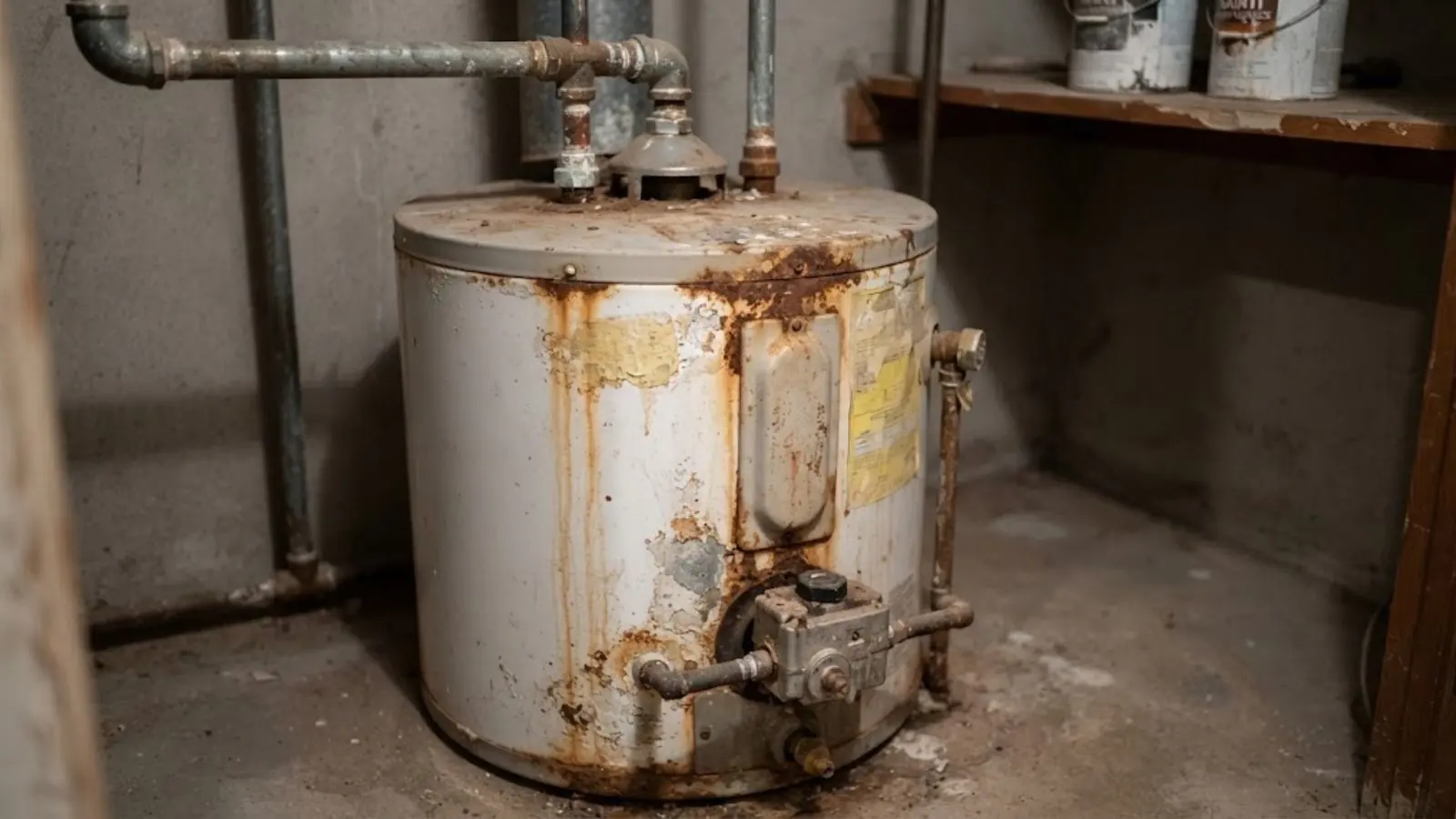
A typical tank water heater lasts roughly 8 to 12 years. Tankless units are often rated for longer when they are flushed on schedule. Bedford homes are on moderately hard water, so a tank that is never flushed can lose years to sediment and scale. A well-kept tank might run past twelve years, and a neglected one can fail in eight.
The age is on the label. The serial number encodes the month and year of manufacture, and the manufacturer's website usually explains the code. If the unit is past ten years, start planning even if it still works.
What wears a tank out
Three things do most of the damage. Sediment builds up on the bottom, forcing the burner or lower element to work through a layer of scale. The anode rod, a metal rod that corrodes so the tank does not, is used up over time. And high water pressure stresses the tank and the fittings every day.
Once the anode rod is gone, the steel tank starts to corrode from the inside. That is why a tank that was never serviced can fail suddenly. The leak appears at the bottom or the seams and cannot be repaired.
Signs a tank is near the end
Rust in hot water
Rust-colored water from the hot side only suggests corrosion inside the tank.
Popping and rumbling
Water trapped under sediment boils and pops as the burner or element runs.
Moisture around the base
Even a small damp patch can signal a failing tank or a leaking fitting. Check it early.
Less hot water than before
A coated element or a broken dip tube shortens the supply.
Tank past ten years old?
Ask a plumber whether to plan a swap.
What you can do to stretch the life
Flush yearly
Drain a few gallons from the drain valve to carry sediment out. A plumber can do a full flush.
Check the anode rod
Have it inspected every few years and replaced if it is mostly gone.
Test the relief valve
Lift the lever briefly once a year. If it will not seat again, replace it.
Check pressure
High pressure shortens life. A gauge on a hose bib shows it, and a pressure reducing valve can fix it.
None of this makes a tank last forever. It does give a unit its best chance to reach the long end of its range and gives you warning before it fails.
Bedford water and tank life
The City of Bedford's 2025 Water Quality Report gives total hardness of 110 ppm. By the USGS scale that is moderately hard. Moderately hard water leaves scale on heating surfaces, which is the main reason a yearly flush matters here.
The report also lists chloramine as the disinfectant and describes a mix of surface water from Lake Arlington and Trinity Aquifer wells. Water chemistry can change through the year, so check the latest report on the City of Bedford website.
Source: City of Bedford 2025 Water Quality Report, USGS hardness scale.
| Type | Typical life | What shortens it |
|---|---|---|
| Tank, gas or electric. | About 8 to 12 years. | Sediment, spent anode rod, high pressure. |
| Tankless. | Often rated longer, with upkeep. | Scale buildup, skipped flushes. |
| Hybrid heat pump. | Varies by brand and care. | Blocked airflow, clogged filter, condensate issues. |
Repair, replace or wait
If your tank is under about eight years old and the problem is a part such as an element or thermostat, repair is usually worth it. If the tank leaks through the shell, if the water is rusty or if you are past ten years with repeated repairs, replacement is the better value.
Waiting has a cost. A tank that fails on its own schedule tends to do so at the worst moment and may flood a garage or closet. Replacing it on your terms avoids a midnight call and lets you choose the unit.
What a failing tank does when nobody is watching
A tank that fails does not warn you politely. The first sign is often water on the floor. Where the heater sits matters, because a unit in a garage on a slab sends water out the door while a unit in an upstairs closet or an attic sends it through a ceiling. Know which situation you have before the tank is old.
A drain pan with a pipe to a safe drain helps in finished spaces. A leak sensor on the floor beside the tank costs little and sounds an alarm at the first drops. Neither prevents a failure, but both limit what a failure costs you.
A simple annual routine
Once a year, check these
- Look at the base of the tank and the connections for moisture or rust.
- Lift the relief valve lever briefly and confirm it reseats.
- Drain a few gallons from the drain valve and watch for sediment.
- Read the temperature setting and keep it at a safe level.
- Write the date on the tank so the next check is easy to place.
Warranty paperwork is worth finding. The label and the manual list the warranty period, and some require a registration. If the tank is under warranty and fails early, the manufacturer may replace the tank, though labor is often not covered. Keep the receipt and the manual in one folder so you can find them in a hurry.
Also note the capacity and the fuel type from the label. Those two facts let a plumber quote a replacement over the phone with far fewer surprises.
Finally, think about location. A heater in an attic or on an upper floor deserves a drain pan and a leak sensor, and a replacement plan, sooner than one in a garage.
Next steps
If your heater has a problem today, see water heater repair. If the answer is a new unit, water heater replacement explains the process. Households thinking about endless hot water can read about a tankless water heater.
The same plumbers serve Hurst.
Water heater lifespan questions
Read the serial number on the label. Most manufacturers encode the month and year in the first digits, and their website explains the code.
In moderately hard water it helps. Removing sediment protects the heating surfaces and reduces popping noises.
If it is past ten years, planning ahead is wise. A scheduled replacement costs less stress than a flood.
Many are rated for a longer life, but they need regular flushing in moderately hard water.
A rod that is mostly bare steel wire has done its job. Replace it to slow corrosion inside the tank.