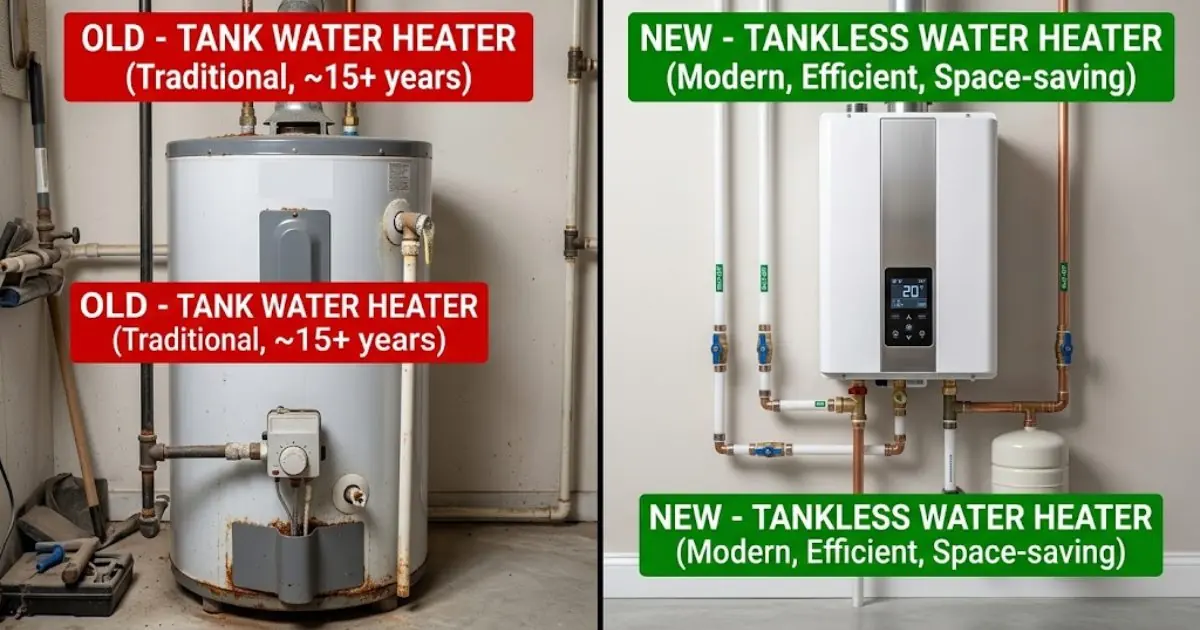
A tank water heater stores a fixed volume of hot water and reheats it as it is used. A tankless heater heats water only as it flows. For most Bedford homes the choice comes down to three things: how much hot water the household uses at once, whether the house can support the gas line or electrical load a tankless needs, and whether the owner will do the yearly flush.
Neither type is better in every case. A tank is simpler and cheaper to install. A tankless unit avoids running out of stored hot water and takes less space, but it asks more of the house and of the owner.
Hot water supply
A 40 or 50 gallon tank can run out when two showers and a dishwasher run in the same hour. After that you wait for it to recover. A tankless unit does not run out, but it has a maximum flow. Run too many fixtures at once and the temperature drops or the unit cannot keep up.
Size matters either way. A tank is sized by its first-hour rating. A tankless unit is sized by flow rate and temperature rise. A plumber should compare the unit to your fixtures, not hand you the model on the truck.
Tank water heater
- Lower purchase and install cost.
- Simple, familiar technology.
- Can run out in heavy use.
- Standby heat loss from the stored water.
Tankless water heater
- Hot water on demand.
- Compact wall mount.
- Higher purchase and install cost.
- Needs a larger gas line or heavy circuit and yearly flushing.
Installation needs
Switching from a tank to a gas tankless often means a larger gas line and new venting. Switching to an electric tankless can require a heavy circuit that many panels cannot spare. These changes are why the installed price is so much higher than the unit price.
A tank replacement is much simpler when the old tank is the same type. Existing connections, vent and wiring are reused.
Weighing tankless against a tank?
Talk through your house and your hot water use.
Upkeep and Bedford water
Tankless heat exchangers run hot and collect scale. In moderately hard water they need a flush on the manufacturer's schedule, and many warranties expect proof. Tanks need a flush too, and an anode rod check.
What the city report says about Bedford water
The City of Bedford's 2025 Water Quality Report lists total hardness of 110 ppm as calcium carbonate, which is moderately hard on the USGS scale. The report also lists chloramine and a pH of 8.8. Hardness is the figure that matters most for scale in a heat exchanger or tank.
Hardness can vary through the year and by location in the system. A tap test gives your own number.
Source: City of Bedford 2025 Water Quality Report, USGS hardness scale.
| Household | Often a good fit | Why |
|---|---|---|
| One or two people, modest use. | Tank. | Lower cost, simple install. |
| Large family, high use. | Tankless or large tank. | Avoids running out. |
| Tight space. | Tankless. | Wall mount frees floor space. |
| House without a large gas line. | Tank or electric hybrid. | Avoids costly upgrades. |
Questions to ask before you decide
Questions worth asking
- Can the house support the gas line or circuit a tankless needs?
- What does the manufacturer require for flushing to keep the warranty?
- What is the unit's flow rate at our incoming water temperature?
- What does the quote include for venting, isolation valves and permit?
- What happens to the old tank?
Gas tankless units are certified to ANSI Z21.10.3, so check the label.
A good plumber answers these without pressure. A salesperson who skips them is selling a unit, not a solution.
Running costs and what to expect over time
Tankless units avoid the standby loss that a tank has while it keeps water hot all day. That saving is real but depends on how much hot water the household uses. A home that uses very little hot water saves less in absolute terms. A busy home saves more.
Maintenance costs belong in the comparison too. A tank needs a flush and an occasional anode rod. A tankless unit needs a descaling flush on the manufacturer's schedule, and the parts can cost more when something fails. Ask what service the plumber recommends and how often.
What happens when it fails
A tank fails by leaking. A tankless unit fails by showing an error code or going cold. Tankless failures rarely flood a room, which is a point in their favor for second-floor installs. The tradeoff is that parts may need ordering, so a few days without hot water is possible.
If you cannot be without hot water for a day, ask whether the plumber stocks parts for the brand you are considering.
A decision guide in three questions
First, can your house support a tankless unit without a major upgrade? If the gas line is too small or the panel has no room for a heavy circuit, the price climbs fast. Second, how many fixtures run at once in your busiest hour? If the answer is two or fewer, a good tank is usually enough. Third, will you flush the unit on schedule? If not, a tank is more forgiving.
If you answer yes to the first, high to the second and yes to the third, tankless is worth a serious quote. Otherwise, a quality tank with a plan for yearly flushing is a sound choice.
Ask the plumber to put the comparison in writing: the cost of each option installed, the expected maintenance and the warranty terms. A one-page comparison makes the decision easier for everyone in the household and gives you a record if questions come up later.
Related pages
For service on an existing tankless unit, see tankless water heater. Ready to swap a failing tank? Read water heater replacement. Planning a new install? Water heater installation covers the steps.
We also serve Hurst.
Tankless versus tank questions
It does not run out of stored water, but it has a maximum flow. Too many fixtures at once can exceed it.
It avoids standby heat loss, which can lower running cost. Savings depend on how much hot water you use.
It depends on the gas line size or electrical panel capacity. A plumber can check both.
Follow the manufacturer schedule. Many plumbers suggest yearly in moderately hard water like Bedford's.
Yes. Plan for flushing, because scale builds on the heat exchanger in moderately hard water.