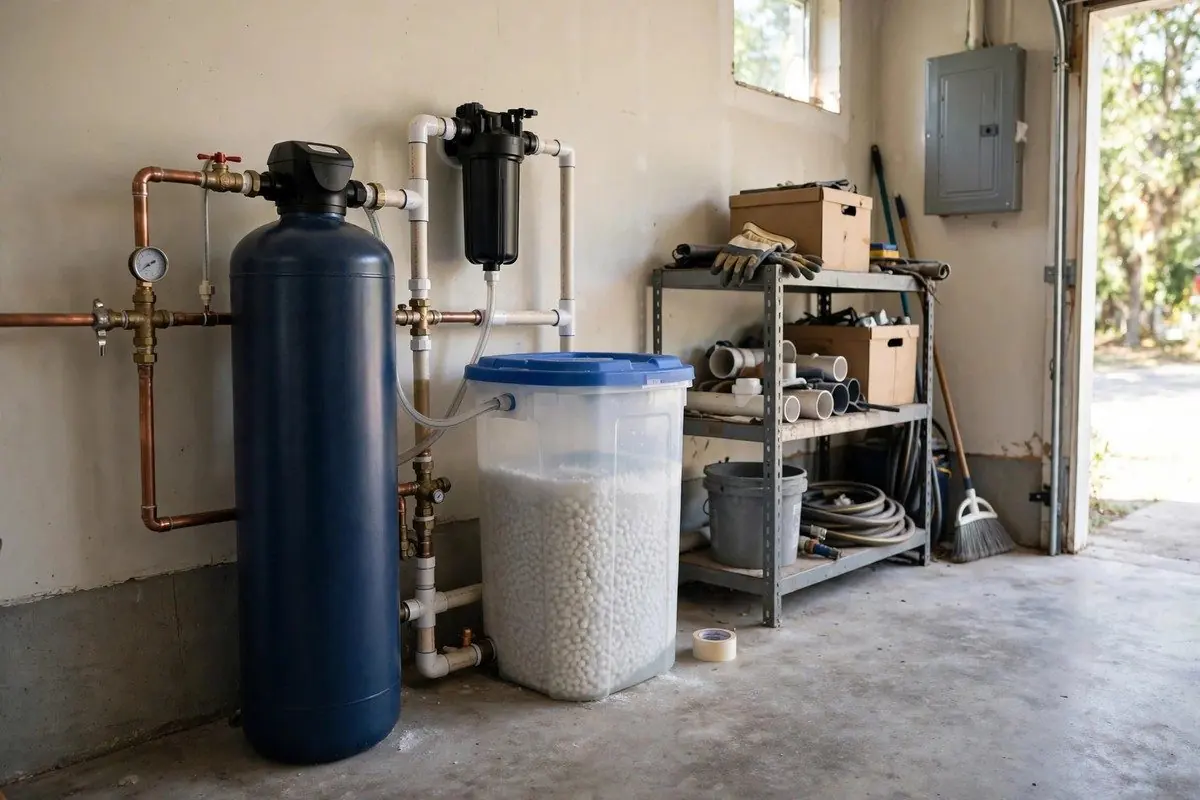
Water softener installation in Bedford, TX starts with the facts about your water. The City of Bedford's 2025 water quality report lists total hardness of 110 ppm as calcium carbonate. That is about 6.4 grains per gallon, which is our conversion. The USGS scale calls water in that range moderately hard.
That is not the hardest water in Texas, so a softener is a choice, not a necessity. Plenty of homes live with it. Others prefer to soften the water because scale builds on faucets, shower doors, water heaters and heating elements over time.
What the water report says
Bedford buys treated water supplied through the Trinity River Authority's Tarrant County Water Supply Project from Lake Arlington and also draws on Trinity Aquifer wells at Stonegate and Simpson. The same report lists a pH of 8.8 and chloramine as the disinfectant. Hardness can vary through the year and across the system, so test your own tap.
Hardness figure
The report lists 110 ppm total hardness. Your tap may differ slightly, so a simple test kit or a lab test gives a better number.
Chloramine
Chloramine is the disinfectant in the supply. A softener does not remove it, but some filters are designed to reduce it. Ask what a product is certified to do.
Water heater effect
Scale shortens the life of tank water heaters and tankless heat exchangers. Softening reduces scale but does not replace yearly flushing.
Check your own tap
Ask the City of Bedford for the current water quality report and test your water if you want exact numbers.
Softener, filter or both
A softener swaps hardness minerals for sodium or potassium. It addresses scale. A filter addresses taste, odor or particles, and different filters do different jobs. Reverse osmosis at a single tap treats drinking water. Many households need one of these, not all of them.
Whole-home softener
- Reduces scale on fixtures and appliances.
- Softer feel on skin and laundry for many users.
- Needs salt or potassium refills.
- Needs a drain and power outlet.
Filter or reverse osmosis
- Targets taste, odor or specific contaminants.
- Works at one tap or the whole home.
- Needs filter changes.
- Does not remove hardness unless designed to.
| What you notice | Likely help | Note |
|---|---|---|
| White scale on faucets and glass. | Water softener. | Reduces hardness minerals. |
| Chlorine or chloramine taste. | Carbon filter at the tap or whole home. | Check the product certification. |
| Cloudy ice or particles. | Sediment filter. | Replace the cartridge regularly. |
| Drinking water quality concerns. | Reverse osmosis at the kitchen tap. | Wastes some water in operation. |
What decides the price of a softener install
What moves the price
The system, the location and the plumbing connections set the price. A written price comes before work starts.
Insurance does not cover planned water treatment upgrades. If a failed unit caused water damage, your policy may cover the damage but not the unit.
Want your real number? Describe the job to the plumber on the 24/7 line and ask for a price before work starts.
What to do before you buy a treatment system
- Read the latest City of Bedford water quality report and note the hardness figure.
- Test your own tap so you have a number from your home.
- Decide whether scale, taste or both is the problem you want to solve.
- Ask for the NSF/ANSI standard and the tested claim on any product.
- Get the installed price, salt or filter costs and the warranty in writing.
Standards and codes behind the work
Softeners are tested under NSF/ANSI 44, and carbon filters and reverse osmosis units under NSF/ANSI 53 and 58. A product label that names the standard and the contaminant it was tested for is the claim to look for.
Want to talk about your water?
Call and describe what you see at the tap.
Related pages
Scale also affects heaters, so see water heater installation and tankless water heater for flushing advice. New fixtures are covered under plumbing installation.
We also serve Hurst.
Water softener questions from Bedford homeowners
The City of Bedford's 2025 water quality report lists total hardness of 110 ppm. That is moderately hard on the USGS scale, and your tap may vary.
Not necessarily. It depends on whether scale and spotting bother you. A softener helps with scale but costs money to buy and maintain.
No. A softener addresses hardness. Some carbon filters are designed to reduce chloramine, so check what a product is certified to do.
It should not. Softened water has a small amount of sodium or potassium added, and some people notice a difference.
Yes, with a test kit. You can also ask the City of Bedford for its latest water quality report.
Many installs take a few hours, depending on the location and the plumbing changes needed.