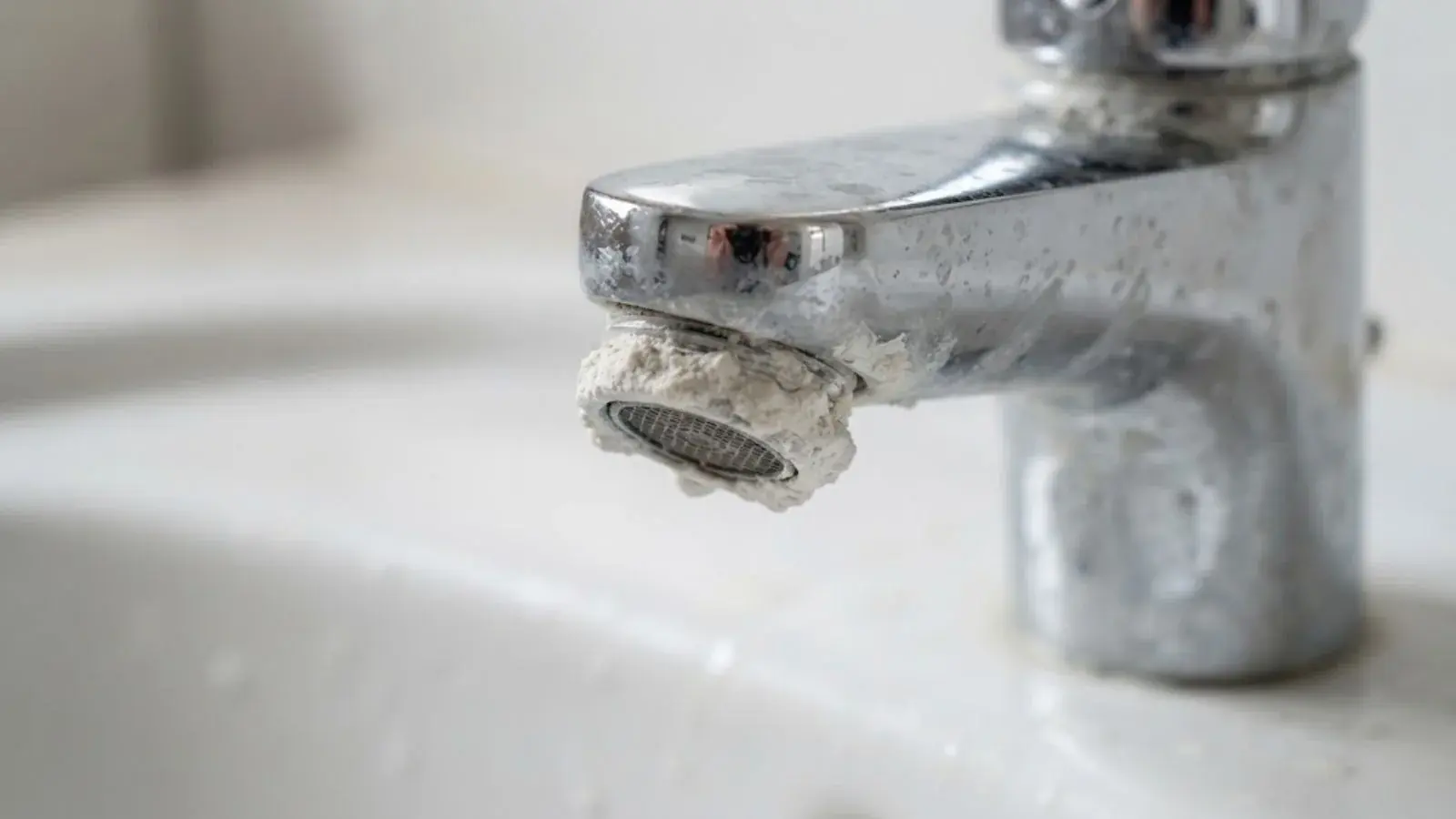
Bedford water is moderately hard. The City of Bedford's 2025 Water Quality Report lists total hardness of 110 ppm as calcium carbonate. Converted at the standard factor, that is about 6.4 grains per gallon. The conversion is ours, not the city's. The USGS scale calls water in the range of roughly 61 to 120 mg/L moderately hard.
Moderately hard water is not unusual and many households live with it. It leaves white scale on faucets and glass, builds up inside water heaters and can shorten the life of heating surfaces. Whether to treat it is a choice about cost, convenience and what bothers you.
What the report shows
| Item | Reported value | What it means |
|---|---|---|
| Total hardness. | 110 ppm as calcium carbonate. | Moderately hard on the USGS scale. |
| pH. | 8.8, with a range of 7.4 to 8.8. | Slightly alkaline water. |
| Disinfectant. | Chloramine. | Used to control microbes. |
| Sources. | Lake Arlington water through the Trinity River Authority, plus Trinity Aquifer wells. | A blend, so numbers can shift. |
The report also notes that Fort Worth supplied water through an emergency interconnect on several days in March and April 2025 while repairs were made. When the source changes, hardness at your tap can change too.
What hardness does at home
Scale on fixtures
White crust around faucets, showerheads and glass is dried minerals.
Water heater buildup
Sediment collects at the bottom of the tank and on heating surfaces.
Reduced flow
Aerators and showerheads clog with scale over time.
Spots on dishes
Dishwasher loads can come out cloudy or spotted.
Curious about softening?
Describe what you see at the tap and ask for options.
Is a softener worth it?
Reasons to consider one
- You see scale and spotting every week.
- You have a tankless heater that needs frequent flushing.
- You want softer feel in laundry and skin.
- You are willing to maintain it.
Reasons to skip one
- Scale does not bother you.
- You flush the water heater yearly.
- You want to avoid salt or a drain connection.
- You prefer a lower-cost fix like a showerhead filter.
Look for NSF/ANSI 44 on a softener and NSF/ANSI 53 or 58 on filters and reverse osmosis units. Those are the published standards for the claims on the box.
A softener does not remove chloramine. If taste or smell is your concern, a carbon filter or a reverse osmosis unit at the kitchen tap may help instead. Check what a product is certified to do before buying.
Check your own tap
Hardness in a water report is an annual figure or a sample result. Your tap may differ. A simple test strip or a lab test gives a better picture of your home.
The City of Bedford publishes its annual water quality report on its website. Read it for the year in question and ask the Public Works department if you have questions about the supply.
Source: City of Bedford 2025 Water Quality Report, USGS hardness scale.
Low-cost steps before you buy anything
Cheap steps that help
- Flush the water heater once a year to remove sediment.
- Soak clogged aerators and showerheads in vinegar to remove scale.
- Wipe fixtures dry to reduce spots.
- Test your own tap so you know your actual hardness.
If you decide a softener is worth it, size it to your household use and your hardness. A plumber can set it up with a bypass valve, a drain connection and an electrical outlet.
Hardness, pH and chloramine are different things
People often use hard water as a catch-all for any problem at the tap. The city report lists several different values, and each does something different. Hardness is about dissolved calcium and magnesium and causes scale. The pH describes how acidic or alkaline the water is. Chloramine is a disinfectant and affects taste and smell for some people.
A softener only addresses the first. If your complaint is a chlorine-like taste, a filter does more for you than a softener. If your complaint is spots on glass, the reverse is true. Match the fix to the symptom.
What to do with a test result
If you test your own tap and the number is close to the city report, you have a baseline. If it is much higher, the water may be picking up minerals from your own plumbing or the sample point may differ. If it is lower, the source mix may have shifted that week.
A plumber can read your result, look at your fixtures and heater and tell you whether scale is likely to matter at your hardness level.
Keep the result with your home records. If you later decide on a softener, it also helps size the system correctly.
Hard water and appliances
Scale reduces the efficiency of anything that heats water. A tank water heater, a dishwasher, a coffee maker and a steam iron all collect mineral deposits over time. Descaling these with a vinegar-based solution or the manufacturer's recommended product extends their life.
In a water heater, the sediment layer at the bottom insulates the water from the burner or element, so the unit works harder. That is one reason a yearly flush is among the best returns on plumbing upkeep in moderately hard water.
If you have a tankless water heater, scale also narrows the heat exchanger. Many manufacturers specify the flush interval, and a plumber can set it up with isolation valves for easy service.
A practical way to decide is to track what you actually see for a month. Count how often you wipe scale off fixtures, how often the dishwasher leaves spots and whether the showerhead clogs. If the list is short, skip the equipment and keep up with flushing and cleaning. If the list is long, price a softener and compare it with the time you spend.
Ask any seller of treatment equipment for the hardness figure they used to size the system and for the cost of salt or media over a year. Those numbers make a fair comparison possible.
Related pages
Read about water softener installation for system options. Scale and heaters are covered in tankless water heater and water heater installation.
We also serve Hurst, which has its own city water report.
Hard water questions
The 2025 city report lists total hardness of 110 ppm, which the USGS scale calls moderately hard.
Hardness minerals are not generally considered a health problem. They mainly cause scale and spotting.
No. A softener addresses hardness. A carbon filter or reverse osmosis unit may reduce chloramine.
Yes. Test strips give a rough number and a lab test gives a detailed one.
Not necessarily. Hurst publishes its own report and lists connections with Fort Worth. Check its latest report.