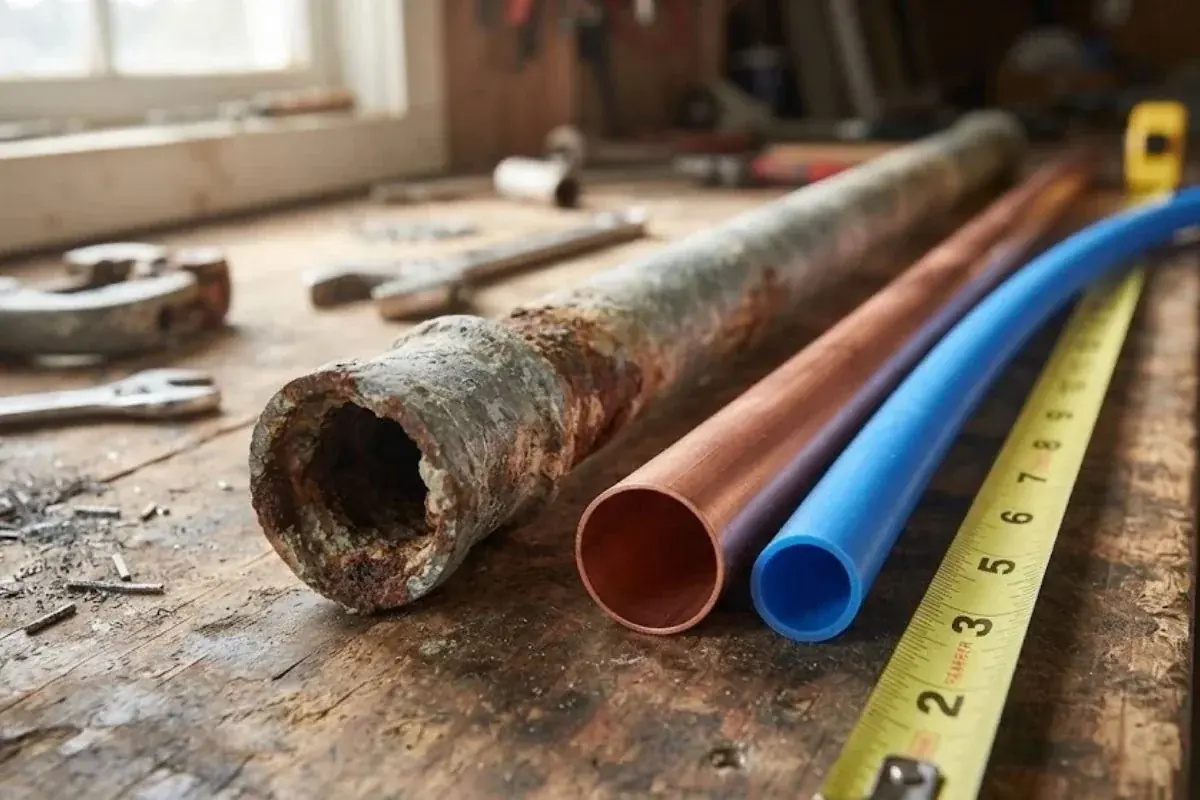
The pipes in a Bedford home depend on when it was built. Galvanized steel was common in older houses, copper became standard for decades after, and polybutylene, a gray plastic, was used in some homes from the late 1970s to the mid 1990s. Each ages differently. Repeated leaks, rusty water and falling pressure are the signs that a home may need repiping.
You can often identify pipe by looking at an exposed section near the water heater, under a sink or in the attic. Color, texture and markings give clues. If you cannot tell, a plumber can identify it in a short visit.
Galvanized steel
Galvanized pipe is steel coated with zinc. The coating wears and the pipe rusts from the inside, narrowing the bore. Symptoms are low pressure, rust-colored water and leaks at threaded joints. It is dull gray and magnetic. Pipe in this condition usually calls for replacement rather than patching.
Copper
Copper is durable and has a long track record. It is orange-brown and may have green corrosion at joints. Copper can develop pinhole leaks, especially where water conditions or flow wear the pipe. A few leaks do not always mean the whole house needs replacing. Many leaks in a short time might.
Not sure what pipe you have?
A plumber can identify it and judge its condition.
Polybutylene
Polybutylene is flexible gray plastic, often with copper or plastic fittings. It has a history of failures and was the subject of large class-action settlements. If you find it, ask a plumber about its condition and about replacement.
| Pipe | How to spot it | Typical trouble |
|---|---|---|
| Galvanized steel. | Dull gray, magnetic, threaded joints. | Rust, low pressure, leaks. |
| Copper. | Orange-brown, soldered joints. | Pinhole leaks, joint corrosion. |
| Polybutylene. | Gray flexible plastic. | Failures at fittings. |
| PEX. | Flexible red, blue or white tubing. | Few issues, protect from sunlight. |
Signs it is time to act
Repeated leaks
More than one in a short time suggests the pipe is wearing out.
Rusty or brown water
Often a sign of corroding galvanized pipe.
Low pressure at all fixtures
Scale and rust narrow the pipe.
Polybutylene found
Ask a plumber for an assessment.
Bedford growth and what it means for pipes
A 2025 KERA News profile reports that Bedford had about 2,700 residents in 1960 and has around 50,000 today. That growth means a large share of homes were built in the decades since, during which these pipe materials were in common use. Your own house's pipe depends on its build year, so check it directly.
The City of Bedford's 2025 Water Quality Report lists a pH of 8.8 and chloramine as the disinfectant. We do not claim any pipe material is immune or doomed in that water. Ask a plumber about your specific pipe.
Source: KERA News, August 22, 2025, City of Bedford 2025 Water Quality Report.
Partial or whole-home repipe
A partial repipe replaces the worst zone, such as one bathroom group. A whole-home repipe replaces all the supply lines. Many owners choose partial first, then continue as budget allows. A plumber can explain the options and how to phase the work.
What a plumber checks to judge pipe condition
A plumber starts with the visible pipe, then measures pressure and flow at several fixtures. Low pressure at one fixture points to a local clog. Low pressure everywhere points to the main line or a narrowing supply. The plumber also looks at joints, valves and any areas of corrosion and asks about past leaks.
A pressure gauge on an outdoor spigot is a quick test. Static pressure that is too high stresses pipes, and one that is too low points to restriction. A plumber can tell you whether a pressure reducing valve is working.
Planning a repipe so it does not ruin your life
A good repipe is phased. The plumber opens small access holes, runs the new lines and patches. Water is off for part of each day and back on at night. Ask about the schedule, the order of rooms and who patches and paints the access holes.
If your insurance is likely to be involved because of a prior leak, ask your agent what they want documented before work begins. Keep photos of the old pipe and the failures.
A permit is typically needed for a repipe. Ask the City of Bedford building inspections office what they require, and ask your plumber who pulls it.
Questions to ask before a repipe quote
Put these to every plumber
- What material will you use and why does it fit my house?
- How many access holes will you cut and who patches them?
- How long will the water be off each day?
- Is the permit included and who handles inspection?
- What does the warranty cover on parts and on labor?
Compare answers, not just totals. A quote that leaves out patching or the permit may look cheaper than it will end up.
Mixed pipe in one house
Many homes have more than one pipe material. A previous owner may have replaced part of the house with copper or PEX and left the rest. Where two metals meet, corrosion can build at the joint, so a plumber uses the right fittings to separate them. A mixed system is not necessarily a bad one, but it deserves a closer look.
When you plan a repipe, ask the plumber to identify every material in the house, including the lines to outdoor spigots and the water heater connections. A complete picture avoids surprises midway through the job.
Keep a sketch of where the lines run. It helps you and the next owner.
Finally, ask whether your home insurance carrier has any requirements about pipe materials. Some insurers ask about polybutylene or galvanized lines when they write or renew a policy, and a plumber's letter that documents the pipe type and condition can help. Keep any letter with your home records, because a future buyer or lender may ask for it.
Related pages
Learn more about repiping. A single failure is covered in burst pipe repair. A leak you cannot find belongs with leak detection.
We also serve Hurst, where growth followed a similar pattern.
Old pipe questions
It is flexible gray plastic, often seen near the water heater or main. A plumber can confirm it.
Copper is durable and has a long record. Pinhole leaks can still occur with age.
It often does once it narrows or leaks. A plumber can test pressure and flow.
No. You can replace the worst zones first and continue later.
New supply lines can remove a concern for buyers, but value depends on the market.